10/30/2015

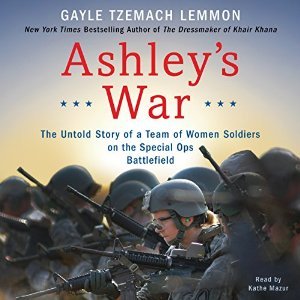
Ashley's War: The Untold Story of a Team of Women Soldiers on the Special Ops Battlefield by Gayle Tzemach Lemmon

From the author of the New York Times best seller The Dressmaker of Khair Khana comes the poignant and gripping story of a groundbreaking team of female American warriors who served alongside Special Operations soldiers on the battlefield in Afghanistan - including Ashley White, a beloved soldier who died serving her country's cause.

In 2010 the US Army Special Operations Command created Cultural Support Teams, a pilot program to put women on the battlefield alongside Green Berets and Army Rangers on sensitive missions in Afghanistan. The idea was that women could access places and people that had remained out of reach and could build relationships - woman to woman - in ways that male soldiers in a conservative, traditional country could not. Though officially banned from combat, female soldiers could be "attached" to different teams, and for the first time women throughout the army heard the call to try out for this Special Ops program.

In Ashley's War, Gayle Tzemach Lemmon uses exhaustive firsthand reporting and a finely tuned understanding of the complexities of war to tell the story of CST-2, a unit of women hand-picked from across the army, and the remarkable hero at its heart: 1st Lt. Ashley White, who would become the first Cultural Support Team member killed in action and the first CST remembered on the Army Special Operations Memorial Wall of Honor alongside the Army Rangers with whom she served.

Transporting readers into this little-known world of fierce women bound together by valor, danger, and the desire to serve, Ashley's War is a riveting combat narrative and a testament to the unbreakable bonds born of war.

~~~~~~~~~~~~~~~~~~~~~~~~~~~~~~

I thoroughly enjoyed listening to this story, and found this book to be fascinating, as I had never heard of the CST program prior to listening to this book. While Ashley White's story was the centerpiece of the book, I liked how the author weaved together several of the women's stories to provide a much more holistic view of the CST program and its participants. These women are inspirational. They came from all across the United States, all with a single-minded goal: to serve their country in the most meaningful way possible. 

Prior to this program, positions on the front lines had been largely closed to women, despite the fact that women have proven both their ability and willingness to serve in the most dangerous environs of war. These women, carefully selected, were in essence pioneers, tasked with proving themselves in a male dominated field resistant to change. They not only had to prove themselves in the moment, but set a prescient that would impact the lives and careers of generations of female soldiers to come. They pushed themselves physically, mentally, and emotionally to serve at the highest standard they could achieve.

Yet, they were human. It could have been really easy to portray these women as "other," something beyond what anyone could hope to achieve, but I think the author did a good job humanizing them. She wrote about their flaws, challenges, hopes, and dreams. She made them unique and ordinary at the same time. This made their characters relatable and I found myself draw in by their stories because I could relate to them and their experiences as women on a personal level.

You don't have to be overly interested in military stuff to get hooked by this book, as the focus is less on that and more on telling the stories of these incredible women. In my opinion, this book is well worth a read (or listen!). 

Milk and Honey by Rupi Kaur

'milk and honey' is a collection of poetry and prose about survival. About the experience of violence, abuse, love, loss, and femininity. It is split into four chapters, and each chapter serves a different purpose. Deals with a different pain. Heals a different heartache. 'milk and honey' takes readers through a journey of the most bitter moments in life and finds sweetness in them because there is sweetness everywhere if you are just willing to look.

~~~~~~~~~~~~~~~~~~~~~~~~~~~~~~

This is a beautiful collection of poems. It's various line drawings are reminiscent of Shel Silverstein, but this is no children's book. The poems cover a spectrum of experiences and emotions, from abuse to finding love to breaking up. They are raw, real, and vulnerable. It is a prime example of how powerful and healing poetic expression can be. Rupi Kaur is my new favorite poet. Love this book.

10/23/2015

Wild: From Lost to Found on the Pacific Crest Trail by Cheryl Strayed

At twenty-two, Cheryl Strayed thought she had lost everything. In the wake of her mother’s death, her family scattered and her own marriage was soon destroyed. Four years later, with nothing more to lose, she made the most impulsive decision of her life. 

With no experience or training, driven only by blind will, she would hike more than a thousand miles of the Pacific Crest Trail from the Mojave Desert through California and Oregon to Washington State — and she would do it alone.

Told with suspense and style, sparkling with warmth and humor, Wild powerfully captures the terrors and pleasures of one young woman forging ahead against all odds on a journey that maddened, strengthened, and ultimately healed her.

~~~~~~~~~~~~~~~~~~~~~~~~~~~~~~

I found this to be a remarkable narrative. I had never heard of the Pacific Crest Trail (PCT) and I am not an outdoorsy girl. I enjoy nature and the occasional hike or bike ride, but I am not the type of girl who likes camping outside with no access to a shower and indoor plumbing. I much prefer "glamping," or glamorous or luxurious camping. Picture something along the lines of a giant RV with an indoor shower, satellite TV, running water, refrigerator, stove, fireplace (optional), and fold-out Queen sized air mattress and you have a inkling into what I define as my version of "camping."

The idea that anyone, let alone a female on her own, would set out into the wilderness carrying all their supplies on their back and walk for miles and miles across unforgiving terrain and be at the mercy of the elements just seems insane to me. No thanks! But I can see why it was appealing to Cheryl at a time when her whole life seemed to be unraveling around her. I admire her courage in undertaking such an endeavor. I felt sympathy for her plight - losing her mother, estrangement from her stepfather and siblings, her divorce. I didn't necessarily agree with how she went about dealing (or not dealing) with her grief. I think in many ways, she was the cause of her own suffering. Nevertheless, I can see how undertaking a solo journey in the wilderness could help one find their way back to themselves. A journey such as the one Cheryl takes strips you of all pretenses. There is nothing and no one to hide behind or distract you from yourself. You have no choice but to face yourself head-on as you push yourself to your limits.

The narrative was humorous and exciting, and I enjoyed hearing about all the people Cheryl met along the way. Cheryl is not a perfect person, as none of us are, and there were certainly decisions she made that I would not make. However, I found myself forgiving her for her folly and recognizing the humanity in her story. Which of us is perfect? Which of us doesn't make mistakes? Who among us is brave enough to face our demons, our imperfections, head on? Who among us hasn't lost their way? Which of us hasn't made excuses for our actions?

I don't know if I can say I felt inspired by Cheryl's story. I will probably never feel an urge to backpack by myself through the wilderness, but I did enjoy her story, one human being to another. 

10/13/2015

Sense and Sensibility by Jane Austen

The first of Jane Austen's published novels, Sense and Sensibility portrays the life and loves of two starkly different sisters: Elinor and Marianne Dashwood.

The elder Elinor is the epitome of prudence, discretion, and self-control: Marianne embodies emotion, openness, and enthusiasm. This contrast results in their attraction to men of vastly different character - and sparks family and societal dramas that are played out around the sisters' romantic attachments.

Secrets, betrayals, and confessions soon complicate the lives of the Dashwoods, whose goal is nothing less than the achievement of perfect happiness. Beyond the polar differences between the two sisters' characters lies the universal dilemma of balancing what we owe to other human beings against our own needs.

In the pages of this novel, Austen - the most insightful and, at the same time, the most entertaining of novelists - demonstrates her gift for irony. As with many of the greatest works of literature, the resolution of this one is ambiguous: It is for the reader to decide whether sense and sensibility have truly merged - if life and love can really coexist.

~~~~~~~~~~~~~~~~~~~~~~~~~~~~~~

Sense and Sensibility is my second favorite Austen novel. I have always felt a kinship with sensible Elinor. Of all the Austen heroines, she is the one I feel is most similar to myself. I have always admired her steadfastness, practicality, and stoic manner. I never could quite understand why Marianne was the beloved one of the two sisters. To me, she has always appeared indulgent, flighty, and overly dramatic. 

The sisters represent the polar opposites, which is what makes this the perfect choice for my reading challenge. 

The Merriam-Webster dictionary defines sense and sensibility as follows:

Sense (noun):
a. capacity for effective application of the powers of the mind as a basis for action or response : intelligence
b : sound mental capacity and understanding typically marked by shrewdness and practicality;also : agreement with or satisfaction of such power 

Sensibility (noun):
a. peculiar susceptibility to a pleasurable or painful impression (as from praise or a slight) —often used in plural
b. awareness of and responsiveness toward something (as emotion in another)

Sensible people are governed by logic. They rely on their heads, their reason. They are willing to sacrifice their own desires in favor of practicality. Where as people who rely on their sensibilities are motivated by their emotions, and are not afraid to respond with unrestrained emotion, positive or negative, in any given situation. Both have their pros and cons, and the message I always got from this novel is the importance of finding the balance between the two. Elinor is often mistaken as being unemotional or detached; Marianne is so easily overcome by any emotion, good or bad, that she appears almost bi-polar.

Of course, there is also Edward Ferrars to consider. As much as I wanted to hate him for it, I have always admired his loyalty and unwillingness to give into the pressures of others. He was a fool to make a promise to Lucy at such a young age, but I have always admired how he refused to break his promise to her, despite the pressure of his family and even to the detriment of his own heart. On the other hand, I always feel an urge to rage at him to forget honor and marry the woman he really loves. Edward is no Mr. Darcy, but he is definitely up there on the list of my favorite leading men.

Even though I have read this book numerous times, I loved it just as much as I did all the other times I read it. Like a pair of comfortable slippers, it was easy to slip into this world created by Austen and lose myself in the language and characters of this novel. This one will never get old for me, and I foresee many more rereadings.

2015 Reading Challenge: A book with antonyms in the title

Room by Emma Donoghue

To five-year-old Jack, Room is the entire world. It is where he was born and grew up; it's where he lives with his Ma as they learn and read and eat and sleep and play. At night, his Ma shuts him safely in the wardrobe, where he is meant to be asleep when Old Nick visits.

Room is home to Jack, but to Ma, it is the prison where Old Nick has held her captive for seven years. Through determination, ingenuity, and fierce motherly love, Ma has created a life for Jack. But she knows it's not enough...not for her or for him. She devises a bold escape plan, one that relies on her young son's bravery and a lot of luck. What she does not realize is just how unprepared she is for the plan to actually work.

Told entirely in the language of the energetic, pragmatic five-year-old Jack, Room is a celebration of resilience and the limitless bond between parent and child, a brilliantly executed novel about what it means to journey from one world to another.

~~~~~~~~~~~~~~~~~~~~~~~~~~~~~~~~~~~~~~~

This was another audio book pick for me, and I must say that I thoroughly enjoyed listening to this story. The audio book was done extremely well, with different actors (is that what you call them? readers?) reading each part. The story is told from the perspective of Jack, which makes for an entertaining and interesting read. Because Room was the only thing Jack knew, having never left it, his perceptions of the "outside" world were both hilarious and heartbreaking. The narrative is full of the innocence and naivete that one would expect from a five year old narrator.

The relationship between Jack and his mother are at the heart of this story. His relationship with his mother was touching and a bit odd. Cut off entirely from the world, these two did what they could to survive. Their interdependence is both natural and unnatural. Jack's mother is perhaps one of the bravest characters I have ever had the privilege to encounter, and I can't even begin to imagine how I would survive, let alone keep a child alive, if I found myself in the same situation. Things don't prove any easier once they do escape. Both Jack and his mother face challenges as they try to integrate into the world beyond their small shelter.

This book deals with some tough topics. It is not graphic per-say, but it certainly doesn't shy away from some of the heavier experiences of the characters. Sorry if that statement seems vague. I don't want to give too much away. Ultimately, this book is about more than just survival. It's about courage, determination, resilience, and the bond between mother and child. I'm curious to see how they will translate such a dramatic and complex story to film, with the film version of Room set to release soon.

I can't speak to the reading of this novel, as I listened to the audio version, but I would recommend giving the audio version a chance. I really feel that the way the audio book was done enhanced the story. It made it more personal. I liked how they used different people to read each part, rather than one person using different voices for each character. It made the reading feel more like a play, rather than a novel. Regardless of the format, I do feel that this novel is worth a read, as it is a very touching story.

9/30/2015

Resilience: Hard-Won Wisdom for Living a Better Life by Eric Greitens

You cannot bounce back from hardship. You can only move through it. There is a path through pain to wisdom, through suffering to strength, and through fear to courage if we have the virtue of resilience.

In 2012, Eric Greitens unexpectedly heard from a former SEAL comrade, a brother-in-arms he hadn't seen in a decade. Zach Walker had been one of the toughest of the tough. But ever since he returned home from war to his young family in a small logging town, he d been struggling. Without a sense of purpose, plagued by PTSD, and masking his pain with heavy drinking, he needed help. Zach and Eric started writing and talking nearly every day, as Eric set down his thoughts on what it takes to build resilience in our lives.

Eric's letters drawing on both his own experience and wisdom from ancient and modern thinkers are now gathered and edited into this timeless guidebook. Resilience explains how we can build purpose, confront pain, practice compassion, develop a vocation, find a mentor, create happiness, and much more. Eric s lessons are deep yet practical, and his advice leads to clear solutions.

We all face pain, difficulty, and doubt. But we also have the tools to take control of our lives. Resilience is an inspiring meditation for the warrior in each of us.

~~~~~~~~~~~~~~~~~~~~~~~~~~~~~~

I saw Eric Greitens give an interview on The Daily Show and was intrigued by the idea of his book. I added it to my "to-read" list and it quickly got lost in the shuffle. As a commuter, I spend a significant amount of time in my car and lose valuable reading time. I have always had mixed feelings about audiobooks. While I like that it allows me to "read" while driving, I miss having a physical book in my hands. However, since I am now spending so much time in my car, I decided to give audiobooks another go. I was pleased to see that my local library had the audio version of Resilience and decided it would be the perfect test subject for determining once and for all if audiobooks were for me.

I have always had the up most respect for our military men and women. I admire their bravery and their willingness to put their lives on the line to protect others. My heart breaks when I hear how they are left unsupported and hurt after they return from the battle lines. I have made it a point to support charities that provide services and help to wounded veterans. But as much as I respect them, the truth is it is hard for me to truly understand their hardships. In our modern era, the divide between civilian and soldier is vast and ever growing. Unlike in the past, our country can be at war without the average citizen ever experiencing one inconvenience. Even though our country is "at war," for the majority of the population it's almost as if the war exists only on TV. Because of this, the men and women who risk their lives for us face little understood challenges as they try to integrate back into civilian life. I fear that in many ways, we fail to adequately support these men and women, and give them what they really need: a purpose. We fail to recognize and utilize their skills, and because of this many of veterans find themselves homeless, unemployed, addicts, or suicidal. We owe these men and women so much, much more than what they get.

In truth, I had a mixed reaction to this book. I liked the idea of the structure, a set of letters written back and forth between friends, but was disappointed how it played out in the book. The book is in fact a set of letters, but it only contains the letters that Eric wrote to his friend, Zach, a soldier suffering from PTSD. The book does not include Zach's responses to Eric, so at times, I felt like I was only getting half of the story. I wanted to know more about Zach's experiences, thoughts, and reactions. While they were at times alluded to in Eric's letters, I was disappointed that the book turned out to be more of a one-sided conversation. 

I did not find anything in this book to be ground-breaking or even mind-blowing, but I think that was the point. Eric draws on the writings of ancient philosophers and past thinkers to discuss the idea of what it means to be resilient. The "wisdom" found in these pages is nothing new, because the idea of what makes a resilient person is not anything new. I think the biggest thing that stuck me is how Greitens talks about how we perceive our suffering. When faced with pain, we (meaning humans in general) often see our situation as unique and therefore incapable of being understood by others. But the truth is, our experiences are not unique. Losing a brother in battle is no different from losing a brother to cancer. The experience or circumstance is different, but the result and the pain is not. The idea that our pain is not unique is like a slap in the face. It's an idea that is harsh, but ultimately I have to agree with Greitens. It's true. It's a liberating truth, in my opinion. If our suffering is not unique, it lifts the burden of having to carry it on our own. It frees us to connect with others and share pain, making it easier to carry.

The other point that I found interesting is that Greitens says that veterans often falter after returning home because society gives them a free pass. We allow them to indulge in their suffering by removing any responsibility or accountability in an effort to "make things easier" for them. We make excuses for them, thinking that we are helping. Greitens says that in fact what we need to be doing is holding them accountable and helping them find a purpose. Our servicemen and women go from having a clear purpose, being part of team, with every minute of every day regimented and controlled, back to a life where the objective and the routines they are accustomed to no longer exist. Greitens goes on to say that anyone who lacks purpose will find themselves in a similar position. I thought this was a very interesting point of view that makes perfect sense when you stop and think about it.

In the end, I thought the arguments that Greitens laid out in the book where not particularly revolutionary, but I surmise that was not the intent. Many of the ideas in the book came across as common sense and universal, which seemed to be the point. One cannot escape suffering, this is perhaps one truth that we can all agree on, but how we chose to deal with that suffering is our choice. I am glad that I read the book, but didn't experience anything profound enough that will have me returning to its pages again and again. It was a good audiobook and I liked listening to the author read the letters. It felt more personal that way. Overall, an intriguing read with useful insights.
9/27/2015

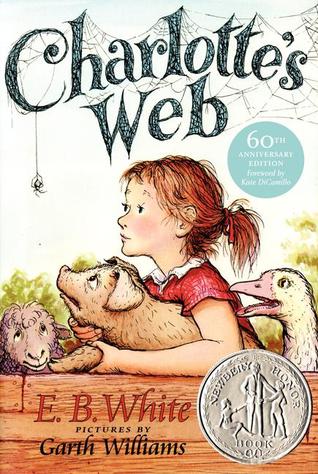
Charlotte's Web by E.B. White

Some Pig. Humble. Radiant. These are the words in Charlotte's Web, high up in Zuckerman's barn. Charlotte's spiderweb tells of her feelings for a little pig named Wilbur, who simply wants a friend. They also express the love of a girl named Fern, who saved Wilbur's life when he was born the runt of his litter.

E. B. White's Newbery Honor Book is a tender novel of friendship, love, life, and death that will continue to be enjoyed by generations to come. It contains illustrations by Garth Williams, the acclaimed illustrator of E.B. White's Stuart Little and Laura Ingalls Wilder's Little House series, among many other books.


~~~~~~~~~~~~~~~~~~~~~~~~~~~~~

This was one of my favorite books growing up. In fact, I still have my childhood copy. The dust jacket is long since missing, the pages are yellowed and stained, the binding is broken, and it has that old book smell. I can still remember sitting with my mother and reading it for the first time. It has been years (decades even) since I had picked it up, so it was a no-brainer for me which book I would chose to fulfill the book from your childhood category for my reading challenge.

Unlike so many other things, this book has not lost it's shine. It is just as good now, as I remember it being when I was a child. I have been so disappointed by films and other books that I have rewatched/reread as an adult, only to find that they lack the luster my memory painted them with. This was not the case with Charlotte's Web. I loved Wilbur and all the other animals. I even loved Charlotte, despite my rather intense loathing of spiders. All the feelings I associated with this novel in my memory - love, joy, sadness, laughter - where all still there as I reread its pages.

This book remains a classic for me and I hope that I will someday be able to share it with my children some day. It is a book that has and will continue to stand the test of time. It is a simple story with tremendous heart. It is a story about love, friendship, and the cycle of life. I love it just as much today as I did as a child. It's nice to know some things never change. 

2015 Reading Challenge: A book from your childhood